 Swiss quality
Our method
Our method,from placement test to certificate.
A language school is judged on what happens between the first meeting and the certificate. Here is what we do, in order.
Five principles,applied in every course.
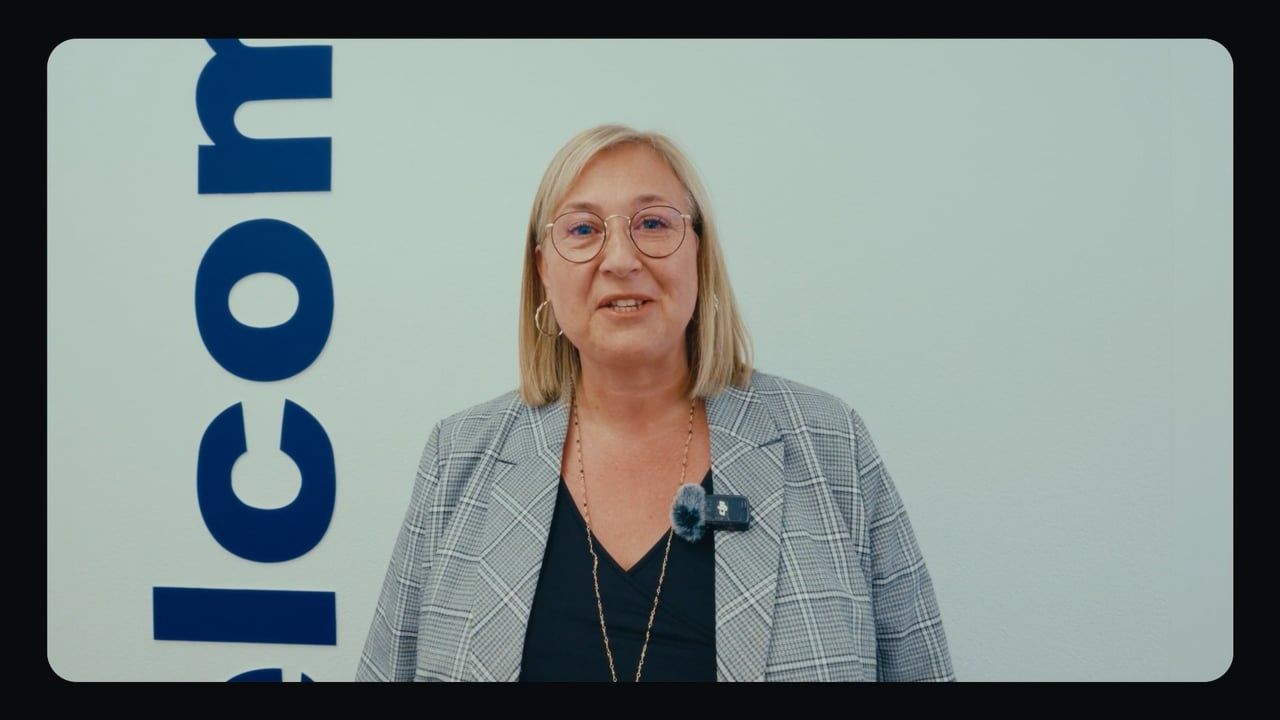
Our teachers train continuously in pedagogy, cognitive psychology and neuroscience. These five principles structure their practice. They are not optional.
Memory
Learn fast. And for good.
Our brain has three memories: short-term, working, long-term. Each has its limits. Your teachers measure what your short-term memory really absorbs, then pace each lesson accordingly.
What it changes for youYou retain more vocabulary, and you have not forgotten it a week later.
Mistakes
A mistake is not a failure.
The brain learns through feedback on its predictions: making mistakes is the very mechanism of learning. Your teachers identify how you relate to mistakes, dismantle the blocks, and turn them into a tool.
What it changes for youYou dare to speak. You stop censoring yourself. You progress because you take risks.
Emotions
Learning with pleasure means learning faster.
Positive emotions strengthen retention, negative ones block it. Your teachers create an environment where learning triggers curiosity, pleasure and confidence.
What it changes for youYou come back every week because you want to. Not out of duty.
Reflection
Learning how to learn.
Beyond the language course, you become aware of how you learn. You notice what works for you, and you adjust. That skill stays for life.
What it changes for youYou become autonomous. A third or fourth language can come later, without us.
Your profile
Every person is unique.
We all learn differently, depending on sensitivity, motivation, history. Your teachers identify your profile in the first sessions and adapt the course accordingly.
What it changes for youYour course looks like you. Not a standard programme applied without thought.
Who teaches
Teachers who teach a language they use every day. Their qualifications are part of what the audit checks.
A level is measured, not guessed
It all starts with a test that places you on the European scale, from A1 to C2. A badly matched group loses the beginner and bores the advanced learner.
The result does two things: it puts you in the right course, and it writes down the goal you want to reach.
The basics
You introduce yourself, you order, you understand simple sentences.
Independence
You hold a conversation, you follow a meeting, you travel without getting stuck.
Professional ease
You negotiate, you present, you write without hunting for words.
You speak from the first lesson
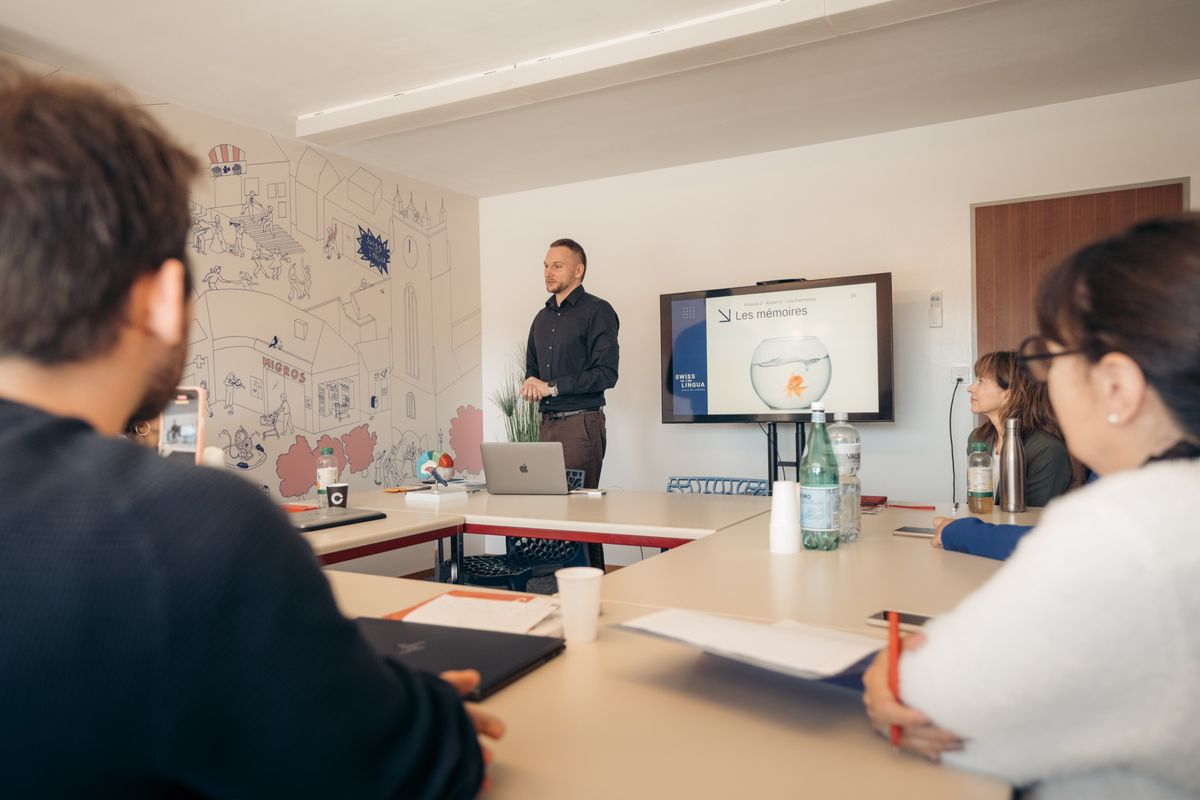
Grammar answers a need, never comes before it. Every lesson starts from a situation you actually live: a meeting, a call, an interview.
That's the part that scares people. It's learned in a small group, with someone who corrects without belittling.
What moves forward is written down
Your teacher records attendance, the points covered, and what still resists. You know where you stand without having to ask.
In companies, HR sees the same overview. It never sees what is said in class.
Certificates
The exams we prepare you for
Goethe, telc, Cambridge, First, DELF and DALF, IELTS, CELI, DELE. The exam is sat at the awarding body, never here.
We prepare you for the exam. No serious school guarantees you'll pass it.
Quality
Teaching audited every year
eduQua is the Swiss label for continuing education providers. The audit covers teacher qualifications, how lessons run, and how feedback is handled.
We also ask learners for their views at regular intervals. What they answer changes the courses that follow.
Where the school comes from
The first class opens in 1999, in Fribourg. A second school follows in Estavayer-le-Lac. Since then, 5'432 people have taken our courses.to confirmFigure awaiting sign-off: the existing pages contradict each other.
Swiss label
An independent body reviews the certification every year. It checks teacher qualifications, how lessons run, and how feedback is handled.
See the labelWe recruit all year round
Do you teach?
You teach your mother tongue, pedagogy matters to you, and applied neuroscience speaks to you? Write to us.
Training today meansseeing further.
Another language opens doors. Professional, personal, geographical. And learning, at any age, also keeps the memory sharp.

It takes about thirty minutes and tells you where you stand. You decide afterwards, or you don’t.